| Home | Nature Weekly Index |
| Last Note | Next Note |
25 October 2026 | Wild Visitors (Part 1) | Minibeasts |
It has been a while since I took stock of the wildlife visiting my home, particularly the small green space along my balcony. I last wrote about this topic more than 10 years ago, in May 2016.
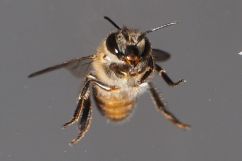
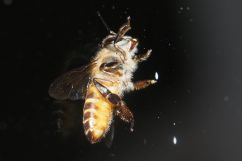
First is the Asian Honey Bee (Apis cerana) (Fig. 1). These bees visited occasionally, usually in the early morning, and often clung to the outside of my transparent window panel. The clear glass allowed me to photograph them from different angles at close range without disturbing them.
 |
 |
 |
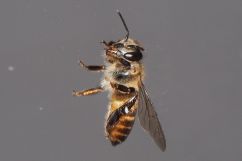 |
| Fig. 1: Asian Honey Bee (Apis cerana) seen on the glass of my window on 11 June. | |||
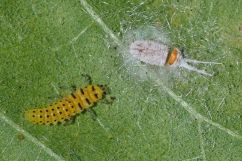
Next, I spotted a larva (Fig. 2) of the Yellow Ladybird Beetle (Illeis koebelei) on my potted mulberry plant (Morus alba) on 12 June. A mealybug was nearby, although the two were probably unrelated. Because this beetle larva feeds on powdery mildew, its presence indicated an infestation—and the mulberry leaves were indeed covered with mildew. I had grown the plant from a stem cutting and eventually found three larvae on it. I waited several weeks for them to become beetles before pruning the affected leaves, although the mildew will probably return when new leaves emerge. I previously wrote about this beetle in May 2017.
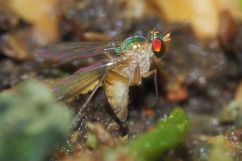
A species of long-legged fly (Fig. 3) from the family Dolichopodidae regularly visits my pots, especially those with decomposing material on the soil surface. It may belong to the genus Neurigona. Over time, I have observed these flies laying eggs on the decomposing material. Although the eggs are too small to see, I occasionally notice newly emerged flies drying their wings around the pots. So far, they appear to be solitary.
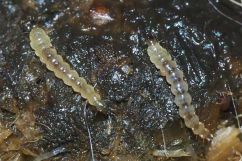
I also found tiny, unidentified larvae (Fig. 4) feeding on the cylindrical rabbit droppings placed in the pots, though I am unsure whether they are related to the long-legged flies. A species of hoverfly (Fig. 5) from the family Syrphidae also visits occasionally and appears to lay eggs on the decomposing material. I last saw one on 4 September and identified it as Syritta orientalis. The mysterious larvae may therefore be associated with this hoverfly instead.
 |
 |
 |
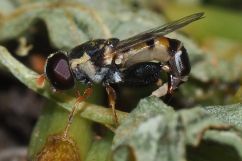 |
| Fig. 2: Larva of Yellow Ladybird Beetle (Illeis koebelei) | Fig. 3: Long-legged Fly (family Dolichopodidae) | Fig. 4: Unknown larvae | Fig. 5: Hover fly (Syritta orientalis) |
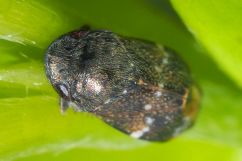
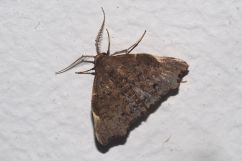
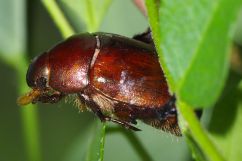
Four other insects visited in June: a Typical Leafhopper (Neodartus acocephaloides) (Fig. 6), an Erebid Moth (Fig. 7), a Scarab Beetle (Anomala obsoleta) (Fig. 8), and a Common Oriental Trap-jaw Ant (Odontomachus simillimus) (Fig. 9). The trap-jaw ant came from a nest in a pot containing Black Ginger (Curcuma aeruginosa). A queen probably landed there in June and founded the colony. I searched for the nest after noticing several ants roaming the concrete floor below the pot, as this species is not usually part of the ant community around my home. The colony now appears likely to die out: in recent days I have seen only one ant, compared with several each day in September.
 |
 |
 |
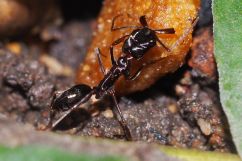 |
| Fig. 6: Typical Leafhopper (Neodartus acocephaloides) | Fig. 7: Erebid Moth (family Erebidae) | Fig. 8: Scarab Beetle (Anomala obsoleta). | Fig. 9: Common Oriental Trap-jaw Ant (Odontomachus simillimus) |
To keep this post manageable, I will continue with part two next week.