| Home | Nature Weekly Index |
4 October 2026 | Sunshine Tree Community | Plant Pests |
 |
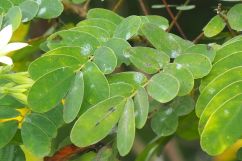 |
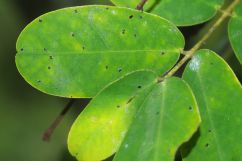
| Fig. 1: Tiny dark spots and white patches found on the leaflets of Sunshine Tree (Senna surattensis). | |
While checking the Asystasia intrusa (African Coromandel) last week at the neighbouring park, I found a row of four Sunshine Trees (Senna surattensis) heavily infested with pests. Their leaves and flowers appeared unhealthy, with the leaflets covered in tiny black spots and white patches (Fig. 1).
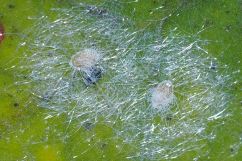
The white patches indicated the presence of whiteflies, with both adults and nymphs on the leaflets (Fig. 2). The nymphs were light brown, surrounded by a whitish fringe and covered with dense, fine, thread-like strands, while the adults were white. Based on images in two publications from India [1-2] and on the iNaturalist website, these were probably Bondar's Nesting Whiteflies (Paraleyrodes bondari). According to the publications, this species is distinguished by an “X”-shaped marking on the adult forewing.
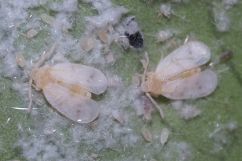
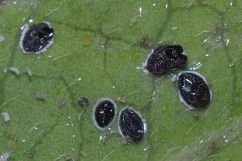
I also noticed whitefly adults with yellow bodies. I initially suspected they were young Bondar's Nesting Whiteflies, but they proved to be another species associated with the tiny black spots on the leaves. Closer inspection confirmed that the spots were whitefly puparia (Fig. 3). After further checks, I believe they were Acacia Whiteflies (Tetraleurodes acacia). Images on iNaturalist show that this species has black puparia and adults with white wings and yellow bodies. Finding two whitefly species on the same host plant was particularly interesting.
 |
 |
 |
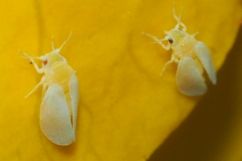 |
| Fig. 2: Nymphs and adults of Bondar's Nesting Whitefly (Paraleyrodes bondari). | Fig. 3: Puparia and adults of Acacia Whitefly (Tetraleurodes acacia). | ||
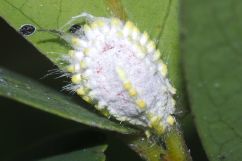
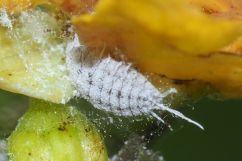
Besides whiteflies, the tree also hosted Icerya seychellarum (Seychelles Scale) (Fig. 4) and Pseudococcus longispinus (Long-tailed Mealybug) (Fig. 5). Although these pests were more conspicuous, they were far less numerous than the whiteflies. Seychelles Scale is known to attack 166 host plant genera across 63 families [3].
 |
 |
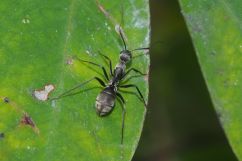 |
| Fig. 4: Icerya seychellarum | Fig. 5: Pseudococcus longispinus | Fig. 6: Camponotus parius |
Plant pests such as whiteflies, mealybugs and scale insects are commonly accompanied by ants, and this case was no exception. At least three ant species were present on the Sunshine Trees: Tapinoma melanocephalum (Ghost Ant), Anoplolepis gracilipes (Yellow Crazy Ant) and Camponotus parius (Shimmering Carpenter Ant) (Fig. 6), reflecting the prominent ant populations in the area. I had previously confused Camponotus auriventris with Camponotus parius. After reading Martin's post and finding no Singapore observations of Camponotus auriventris on iNaturalist, I moved the images previously labelled as that species to the Camponotus parius page on my website.
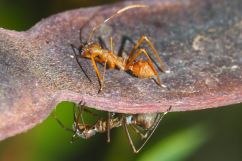
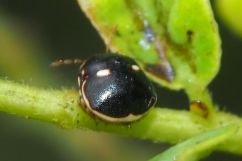
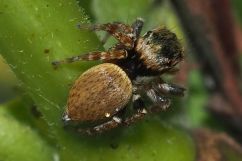
Four other minibeasts were also spotted on the Sunshine Trees. Several that resembled Weaver Ants (Oecophylla smaragdina) were actually nymphs of the broad-headed bug (Riptortus pedestris) (Fig. 7). I also found a few small, rounded shield bugs (Coptosoma variegatum) (Fig. 8) from the family Plataspidae, a jumping spider (Carrhotus sannio) (Fig. 9) from the family Salticidae, and a small beetle (Araecerus levipennis) (Fig. 10) from the family Anthribidae.
 |
 |
 |
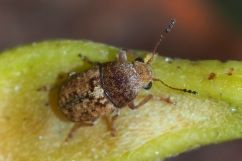 |
| Fig. 7: Riptortus pedestris (nymphs) | Fig. 8: Coptosoma variegatum | Fig. 9: Carrhotus sannio | Fig. 10: Araecerus levipennis |
The beetle Araecerus levipennis is a seed predator of Leucaena leucocephala (White Leadtree) [4]. Both White Leadtree and Sunshine Tree belong to the family Fabaceae. The beetle's common name, Koa Haole Seed Weevil, refers to its predation on the seeds of Koa Haole (Leucaena glauca) [5], which is now recognised as a synonym of Acaciella glauca.
Reference:
[1] Sadhana V, Senguttuvan K, Murugan M, Manikanda BN, Sathiah N. First record of Bondar's nesting whitefly, Paraleyrodes bondari Peracchi (Hemiptera: Aleyrodidae), occurrence and infestation in the cotton ecosystem of Tamil Nadu, India. Pharma Innovation J 2021;SP-10(10):1278-1284. | Read article |
[2] Suriya S, Sadhana V, Madhanram G, Vengatesh KM, Maheshwari S. Bondar's nesting whitefly, Paraleyrodes bondari Peracchi - A threat to coconut ecosystems. Farm Chronicle 2025;4(0):13-15. | Read article |
[3] Kim H, Lee S, Lee W. A detection of quarantine scale pest Icerya seychellarum (Hemiptera: Monophlebidae) in South Korea. J Integrated Pest Management 2024;15(1):28. | Read article |
[4] Lu DY, Chen YC, Chen PT, Wu WJ, Wang CP, Chen HW, Wu LH. Ecological dynamics of two seed predators, Araecerus levipennis and Acanthoscelides macrophthalmus, on Leucaena leucocephala. J Applied Entomology 2026;150(4):487-496. | Read abstract |
[5] Sherman M, Tamashiro M. Biology and control of Araecerus levipennis Jordan ( Coleoptera: Anthribidae ). Proceedings, Hawaiian Entomological Society 1955; 16(1):138-148. | Read article |