| Home | Nature Weekly Index |
20 September 2026 | Two Whitefly Species | Family Aleyrodidae | Soft Bug |
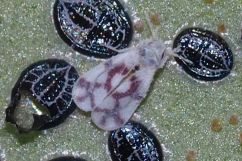
I again noticed many tiny dark spots (Fig. 1) on the undersides of leaves on my potted Bergera koenigii (Curry Tree). I last observed this phenomenon in 2021. From my earlier research, I knew these were whitefly puparia (family Aleyrodidae)—the hardened, cylindrical shells formed from the final larval skins. Some whiteflies may be called blackflies because of the colouration of their puparia or winged adults. However, the term blackfly more commonly refers to a different group of insects.
 |
 |
 |
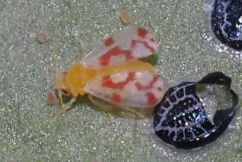 |
| Fig. 1: Black Puparia of Aleurolobus marlatti. | Fig. 2: Adult whitefly, Aleurolobus marlatti. | ||
The puparia and adult whiteflies were less than a millimetre long. I identified them as Aleurolobus marlatti (Fig. 2), based on images of black puparia in two 2012 publications [1, 2]. A 2015 publication from Iraq [3] also included images of the puparia and an adult whose wing pattern matched the whiteflies on my Curry Tree. As of 20 September 2026, iNaturalist had 3 observations of Aleurolobus marlatti, all showing black puparia photographed in China.
A 2007 USDA report (page 137) lists host plants of Aleurolobus marlatti across 28 plant families [4], including Murraya koenigii (Curry Tree) in the Rutaceae family. Murraya koenigii is now a synonym of Bergera koenigii. So far, this is the only plant species on which I have encountered this whitefly. The simplest way to eliminate the infestation is to remove all the leaves. I did this in 2021 and had repeat the process this week.
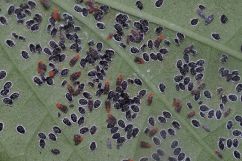
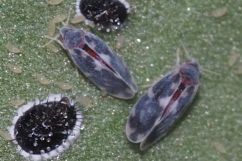
I found the second whitefly with black puparia (Fig. 3) on my potted Piper sarmentosum (Wild Pepper) in March. The infestation was extensive, with large numbers of black puparia covering the undersides of the leaves. Adult whiteflies (Fig. 4) were also present among them. After photographing the puparia and adults, I removed and discarded all the leaves to prevent the infestation from spreading. It has not recurred since.
 |
 |
 |
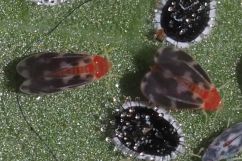 |
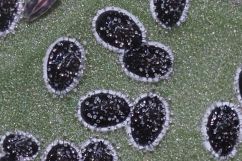
| Fig. 3: Black Puparia of Aleurocanthus spiniferus (Orange Spiny Whitefly). | Fig. 4: Adult whitefly, Aleurocanthus spiniferus (Orange Spiny Whitefly). | ||
I suspect it is an Aleurocanthus species because each black puparium has a white ring and appears to bear spikes. iNaturalist listed 11 Aleurocanthus species. The two most frequently observed were Aleurocanthus spiniferus (Orange Spiny Whitefly), with 140 observations, and Aleurocanthus woglumi (Citrus Black-Fly), with 78.
| Table 1: Aleurocanthus species with host plants in the family Piperaceae [4] | |
| Whitefly species | Host Plant |
|---|---|
| Aleurocanthus pendleburyi | Piperaceae species |
| Aleurocanthus piperis | Piperaceae: Piper nigrum, Piper sp. |
| Aleurocanthus rugosa | Piperaceae: Piper betle |
| Aleurocanthus spinosus | Piperaceae: Piper futokadsura |
| Aleurocanthus valparaiensis | Piperaceae: Piper nigrum |
Initially, I thought the whiteflies were Aleurocanthus woglumi because images of adults on iNaturalist resembled those on my plant. However, the 2007 USDA report lists no Piper species among its host plants (page 89) [4], and the same is true for Aleurocanthus spiniferus (page 87). I then searched the report for whiteflies that use Piper species as hosts. Nineteen species met this criterion, including five in the genus Aleurocanthus (Table 1), but none of those five were available on iNaturalist.
While reviewing publications on Aleurocanthus spiniferus, I found a 2013 article [5] that lists Piper kadsura as a host plant. The species has been reported on 90 plant species across 38 families. The European Food Safety Authority (EFSA) online pest survey card provides a comprehensive account of Aleurocanthus spiniferus and Aleurocanthus woglumi. Based on the EFSA images, I concluded that the whiteflies on my plant are most likely Aleurocanthus spiniferus.
The orange-bodied whiteflies were probably newly hatched, with their colour gradually becoming duller as they developed.
References:
[1] Malumphy C, Mifsud D. Faunal review of the whiteflies of the Maltese Archipelago (Hemiptera, Aleyrodidae). Bull Entomol Soc Malta 2012;5:35-47. | Read article |
[2] Suh SJ, Evans GA. Additions to the whitefly fauna of Korea with a key to species (Hemiptera: Aleyrodidae). Kor J Appl Entomol 2012;51(2):163-170. | Read article |
[3] Al-Nadawi FA. First record of five additional blackflies genus and species in Iraq. Online Int Interdis Res J 2015;V:42-46. | Read article |
[4] Evans, G.A. (2007) The whiteflies (Hemiptera: Aleyrodidae) of the world and their host plants and natural enemies. USDA/Animal Plant Health Inspection Service. | Read article |
[5] Cioffi M, Cornara D, Corrado I, Jansen M, Porcelli F. The status of Aleurocanthus spiniferus from its unwanted introduction in Italy to date. Bull Insectology 2013;66(2):273-281. | Read article |